Showing posts with label Virtualization. Show all posts

Monday, 3 August 2026

What 305-300 exam prep advice often misses

A focused Linux professional looking at a transparent digital interface that reveals complex, interconnected virtualization and containerization infrastructure behind a simpler surface view, representing deeper 305-300 exam prep insights.

Embarking on the journey to earn your LPIC-3 Virtualization and Containerization certification is a significant step for any Linux professional. The official LPIC-3 305 overview page hints at the depth, but often, the widely available 305-300 exam prep advice only scratches the surface. Many candidates find themselves prepared for the theoretical aspects but struggle when faced with the practical, interconnected challenges that this advanced LPI exam truly assesses. This article aims to cut through the noise, offering a realistic, supportive, and honest perspective on what your current study plan might be overlooking for the LPI Virtualization and Containerization V3.0 exam.

We're not just going to tell you to study harder or read more. Instead, we'll delve into the nuances of the LPIC-3 305 exam topics, exposing the critical areas where traditional advice falls short. From understanding the underlying "why" of container orchestration to mastering the subtle interactions between different virtualization technologies, you'll discover how to truly prepare for the rigorous demands of the LPI 305-300 exam.

Decoding the LPI Virtualization and Containerization Exam (305-300)

The LPIC-3 certification is the highest level of multi-distribution Linux certification offered by the Linux Professional Institute (LPI). Specifically, the LPIC-3 305, or LPI Virtualization and Containerization, focuses on proving your expertise in managing virtual machines and container technologies within a Linux environment. This isn't merely a certification; it's a testament to your ability to design, implement, and troubleshoot complex virtualized infrastructures.

Why is this certification so important? In today's cloud-centric world, virtualization and containerization are the foundational pillars of modern IT infrastructure. Companies are constantly seeking professionals who can efficiently deploy, manage, and scale applications using technologies like Docker, LXC, and various hypervisors. Earning your validated LPI credentials for this specialty demonstrates a high level of proficiency that is directly applicable to high-demand roles.

Exam Specifics: What You Need to Know

Before diving into the prep strategies, let's quickly review the core details of the LPIC-3 Virtualization and Containerization exam, code 305-300:

  • Exam Name: LPIC-3 Virtualization and Containerization
  • Exam Code: 305-300
  • Exam Price: $200 (USD)
  • Duration: 90 minutes
  • Number of Questions: 60
  • Passing Score: 500 / 800

Understanding these basics is the first step in any 305-300 exam prep, but true readiness extends far beyond these numbers. It involves a deep dive into the subject matter, a commitment to hands-on practice, and an awareness of the less-talked-about aspects of advanced Linux system administration.

The True LPIC-3 305 Exam Syllabus: What Lies Beneath the Surface

The LPI 305-300 exam syllabus provides a clear outline of the topics covered, along with their respective weightings. While these percentages guide your study, they don't reveal the practical depth and interconnectivity required. Many candidates meticulously follow the LPI LPIC-3 305 exam topics, but a significant portion of what makes this exam challenging is the expectation of applying knowledge across these domains. For a comprehensive breakdown, you can always refer to the detailed LPI 305-300 exam syllabus.

Let's examine each domain, highlighting what often gets missed in standard study guides and how to approach them for the LPIC-3 Virtualization and Containerization V3.0 exam.

Virtualization Concepts and Theory - 6%

Often dismissed as mere definitions, this section is crucial for setting a solid foundation. While understanding hypervisor types (Type 1 vs. Type 2), hardware-assisted virtualization (Intel VT-x, AMD-V), and paravirtualization is essential, the missed advice here is to truly grasp the implications of each. How does the choice of hypervisor impact performance, security, and resource allocation? Think beyond "what it is" to "why it matters" in a production environment. This foundational understanding will inform your approach to specific technologies like Xen and QEMU.

Xen - 3%

Xen might seem like a small percentage, but its implementation requires a nuanced understanding of its architecture: Dom0, DomU, and the Xenstore. Many prep materials focus on basic `xl` commands. What's often missed is troubleshooting Xen domains, understanding different network configurations (e.g., bridged networking for guest access), and practical considerations like live migration limitations. You need to be able to diagnose why a Xen VM won't start or why it has network connectivity issues, not just how to create it.

QEMU - 4%

QEMU is often seen as a standalone emulator, but its power, especially when combined with KVM, is central to modern Linux virtualization. The missing piece in many study plans is the deep dive into its command-line options for device passthrough, snapshot management, and various disk image formats. Understanding the differences between full virtualization and paravirtualization within the QEMU/KVM context is paramount. Don't just memorize; understand how to build and configure a VM from scratch using only QEMU, managing its disks and network interfaces manually.

Libvirt Virtual Machine Management - 9%

This is a significant portion, reflecting its real-world importance. Libvirt is the abstraction layer that manages various hypervisors (KVM, Xen, LXC, etc.). Standard advice covers `virsh` commands like `create`, `start`, `destroy`. What's often missed is the intricate details of Libvirt's XML configuration for domains, networks, and storage pools. How do you hot-add CPU or memory? How do you define a custom network bridge? How do you troubleshoot a VM that fails to import due to XML errors? Mastering Libvirt means understanding its API and XML structure profoundly, not just command invocation. This involves familiarity with various `virsh` subcommands for storage, networking, and snapshot management, which is a key part of any comprehensive 305-300 exam prep.

Virtual Machine Disk Image Management - 3%

While a small percentage, disk image management is prone to costly errors in practice. Beyond knowing `qcow2` and `raw`, you need to understand the practical implications: performance differences, sparse files, resizing, and snapshotting strategies. What's often overlooked is managing disk images across different storage backends (NFS, iSCSI) and how to safely convert between formats without data loss. Practice creating, cloning, and resizing images, and restoring from snapshots in various scenarios.

Container Virtualization Concepts - 7%

This section is the theoretical backbone for LXC and Docker. It's not just about defining cgroups and namespaces; it's about understanding how they enable containerization. What limits do they impose? How do they provide isolation? The often-missed advice is to link these kernel features directly to common container problems, such as resource starvation or security vulnerabilities. Understanding the security implications of shared kernel space versus isolated VM kernels is critical here.

LXC - 6%

LXC provides OS-level virtualization, a precursor and alternative to Docker for specific use cases. Standard prep covers basic `lxc` commands. However, overlooked aspects include advanced LXC networking, persistent storage, and understanding the differences in managing stateful applications within LXC compared to Docker. Practice creating, cloning, and managing LXC containers with custom configurations for networking, resource limits, and device passthrough. Think about using LXC to isolate specific services within a single host, a scenario where it shines.

Docker - 9%

As one of the most popular container technologies, Docker carries a significant weight. Beyond `docker run`, `build`, `push`, and `pull`, the exam demands a deeper understanding. What's often missed? Multi-stage Dockerfiles for efficient image builds, debugging failing containers, understanding various networking drivers (bridge, host, overlay), and persistent data management with volumes and bind mounts. Security aspects like user namespaces and Docker content trust are also key. Don't just know the commands; know how to architect and troubleshoot Dockerized applications. This often includes intricate details on `docker-compose` for multi-container applications and considerations for production deployments.

Container Orchestration Platforms - 3%

This small percentage doesn't diminish its importance. While a deep dive into Kubernetes is likely beyond scope, you need to understand the concepts of orchestration: desired state, self-healing, scaling, and service discovery. What's often missed is how these concepts apply to simpler orchestrators like Docker Swarm or even just managing multiple Docker Compose deployments. Understand the basic components (nodes, managers, workers) and the challenges orchestration solves. It's less about specific Kubernetes commands and more about the fundamental principles of managing many containers.

Cloud Management Tools (Packer, cloud-init, Vagrant) - 2%, 3%, 3%

These tools, collectively representing 8%, are about automation and environment provisioning. The common mistake is to study them in isolation. The missed insight is their role in building reproducible environments. How does Packer create a golden image that can be deployed by a hypervisor? How does cloud-init configure that image on first boot? How does Vagrant provide a consistent local development environment for virtualization and containerization? Focus on their interoperability and how they automate the lifecycle of virtual machines and containers. Practice building a custom VM image with Packer, deploying it, and configuring it with cloud-init scripts. Use Vagrant to spin up a local multi-VM environment for testing your orchestration concepts.

Unmasking the Missed 305-300 Exam Prep Strategies

Beyond the syllabus topics, certain critical aspects of 305-300 exam prep are consistently overlooked in generic advice. These are the areas that truly differentiate an "exam-ready" candidate from one who simply memorized facts.

The Interdependency Trap: Virtualization and Containerization Are Not Separate Islands

Many candidates compartmentalize their study, treating virtualization and containerization as entirely distinct subjects. This is a profound mistake for the LPIC-3 305 exam. In the real world, containers often run within virtual machines. How do you optimize Docker performance on a KVM guest? What networking considerations arise when you have an LXC container running inside a Libvirt-managed VM? The exam expects you to understand these layered environments and their complexities. Your study should focus on scenarios where these technologies intersect and influence each other.

Beyond Command Syntax: Understanding the "Why" and "How"

It's easy to memorize `docker run` or `virsh create`. The missed advice is to understand the underlying mechanisms. Why does `docker exec` behave differently from SSH? How does Libvirt translate XML definitions into hypervisor-specific commands? Why do certain kernel parameters impact container performance? The LPI LPIC-3 305 exam topics demand not just knowing what to do, but why you're doing it and how the system responds at a deeper level. This holistic understanding is crucial for tackling complex, scenario-based questions.

The Troubleshooting Mindset: Debugging Common Issues in VMs and Containers

The exam won't just ask you to configure something; it will test your ability to fix it when it breaks. Standard prep often neglects troubleshooting methodologies. How do you diagnose a VM that won't boot, a container with network issues, or a resource-starved application? This involves knowing log file locations, using diagnostic tools (e.g., `strace`, `lsof`, `tcpdump` within and outside containers), and understanding common failure modes for Xen, QEMU, Libvirt, LXC, and Docker. Practice breaking things and fixing them. This is where real-world experience truly shines.

Resource Management and Performance Tuning: Practical Optimization for Both

Efficiency is key in production environments. Many study guides briefly mention CPU and memory limits. What's missed is the practical application of cgroups for fine-grained resource control, understanding I/O performance bottlenecks in virtual disks, and optimizing network throughput for both VMs and containers. How do you monitor resource usage effectively? When is paravirtualization more efficient than full virtualization, and why? These are the questions that go beyond basic configuration and delve into the operational excellence expected of an LPIC-3 professional. For further insights, consider diving deeper into virtualization challenges and how they impact resource allocation.

Security Contexts: How Virtualization and Containerization Impact System Security

Security is paramount, yet often relegated to a small theoretical section. The missed advice is to consider the security implications across the entire stack. How do SELinux or AppArmor profiles protect containers? What are the best practices for hardening hypervisors? How do you manage secrets in Docker? Understanding attack vectors specific to virtualized and containerized environments, such as container escape vulnerabilities or hypervisor exploits, is vital. Don't just know the security tools; understand how to implement a secure posture for your virtual and containerized infrastructure, ensuring that your LPI LPIC-3 containerization exam objectives extend to robust security practices.

Networking Nuances: Bridged, NAT, Host-Only Configurations for VMs and Containers

Networking can be one of the most complex areas. Beyond basic network setup, the exam likely expects you to understand advanced configurations, troubleshooting network isolation, and connecting different container networks. How do you configure a custom bridge for Libvirt guests? How do you set up a Docker overlay network? What are the implications of using NAT versus bridged networking for external access and security? Practice implementing and troubleshooting complex network topologies involving multiple VMs and containers communicating with each other and the host system.

Persistent Storage Challenges: Managing Data for Ephemeral Containers and VMs

Containers are often designed to be ephemeral, making persistent data management a critical challenge. For VMs, managing storage involves understanding different storage technologies and their trade-offs. What are the best practices for Docker volumes? How do you ensure data persistence across container restarts or upgrades? For VMs, how do you provision storage from shared resources like NFS or iSCSI? The missed advice is to focus on practical, resilient storage solutions that ensure data integrity and availability for both virtual machines and containers.

Leveraging Official Documentation and Community Insights

While third-party 305-300 exam prep materials are valuable, the LPI exam often draws from official documentation. Learning to navigate man pages, info pages, and online project documentation for Xen, QEMU, Libvirt, LXC, and Docker is a skill unto itself. Don't just rely on summarized content; spend time with the source. Furthermore, engaging with Linux communities, forums, and GitHub repositories for these projects can offer insights into common issues and advanced configurations that might appear on the exam. This is the best study material for LPI 305-300, beyond any single book.

Real-world Scenarios vs. Textbook Examples: How to Bridge the Gap

Textbook examples often simplify complex configurations. The LPI 305-300 exam will present real-world scenarios that require critical thinking and an integrated understanding of multiple technologies. Practice building complex, multi-component environments: a Xen host running QEMU guests, a Libvirt network managing multiple Docker containers, or using Packer to create an image that will run containers managed by cloud-init. These types of integrated exercises are far more effective than isolated command practice for mastering the LPIC-3 Virtualization and Containerization exam questions.

Constructing Your Effective LPIC-3 305 Study Guide

To truly pass the LPI 305-300 exam, you need a structured and holistic approach that addresses the nuances discussed above. Your LPIC-3 Virtualization and Containerization study guide should be dynamic and hands-on.

Holistic Learning Approach: Combining Theory and Practice

Don't just read; do. Allocate time daily for both theoretical study and practical application. For every concept, try to implement it, break it, and fix it. This iterative process solidifies understanding far more than passive reading. Focus on understanding the LPI Virtualization and Containerization exam cost as an investment in your career, motivating thorough preparation.

Hands-on Labs are Non-Negotiable: Setting Up Your Own Environment

A dedicated lab environment is crucial. This could be a powerful workstation, a cloud-based VM, or even nested virtualization. Install Xen, QEMU/KVM, Libvirt, LXC, Docker, and experiment with all the tools. Create VMs, build containers, configure networks, and manage storage. The more hands-on experience you gain, the better prepared you'll be for the practical scenarios on the exam.

Effective Use of LPI 305-300 Practice Tests: Simulating the Exam Environment

LPI 305-300 practice tests are invaluable for gauging your readiness and identifying weak areas. However, don't just take them repeatedly. Analyze incorrect answers, understand the underlying concepts, and revisit those topics. Use them to manage your time and familiarize yourself with the question format. Look for questions that mimic real-world problem-solving, not just recall. This is how to pass LPI 305-300 exam effectively.

Mastering LPIC-3 Virtualization and Containerization Exam Questions: Analysis and Understanding

When reviewing LPIC-3 Virtualization and Containerization exam questions, don't just look for the correct answer. Understand why the correct answer is right and why the incorrect options are wrong. This deep analysis enhances your conceptual understanding and prepares you for varied question phrasing. Focus on the LPI 305-300 exam blueprint to ensure your study covers all weighted areas.

Building a Personalized LPI 305-300 Training Course: Tailoring Resources

No single resource is perfect. Combine official LPI documentation, reputable books, online courses, and community forums to build a personalized LPI 305-300 training course. Prioritize resources that emphasize hands-on labs and troubleshooting. Consider an LPIC-3 high availability exam if your career path extends beyond virtualization, as these certifications often complement each other.

Reviewing LPI LPIC-3 305 Exam Topics and Blueprint: Strategic Study

Constantly refer back to the official exam topics and blueprint. Ensure your study plan aligns with the weightings, but remember that "low percentage" topics can still contain critical foundational knowledge or interconnected concepts. The LPI 305-300 exam blueprint is your map; use it wisely.

The Best Study Material for LPI 305-300: What to Look For

The "best" material is subjective, but look for:

  • Content that emphasizes practical labs and troubleshooting.
  • Resources that clearly explain the "why" behind configurations.
  • Materials that integrate virtualization and containerization concepts.
  • Access to realistic LPI 305-300 practice tests that cover scenario-based questions.
  • Updated content that reflects the LPIC-3 Virtualization and Containerization V3.0 curriculum.

The Career Advantage of LPIC-3 Virtualization and Containerization Certification

Earning your LPIC-3 Virtualization and Containerization certification is more than just a badge; it's a significant career accelerator. The demand for skilled professionals in Linux, particularly those with expertise in virtualization and containerization, continues to grow exponentially. This certification validates your ability to manage complex, modern infrastructures, making you a highly sought-after asset.

According to the U.S. Bureau of Labor Statistics, employment of computer and information technology careers is projected to grow much faster than the average for all occupations. This includes roles like Systems Administrators, DevOps Engineers, and Cloud Architects, all of whom benefit immensely from a strong foundation in Linux virtualization certification LPI offers.

The LPIC-3 305 certification demonstrates mastery of core competencies required for advanced Linux system administration and cloud-native environments. It signals to employers that you possess the advanced knowledge and practical skills to tackle real-world challenges, optimize performance, and ensure the security of critical systems. Understanding the LPI LPIC-3 305 certification requirements is a step towards a rewarding career.

Final Steps: Preparing to Schedule Your Exam

Once you've diligently worked through your LPIC-3 Virtualization and Containerization study guide and feel confident in your mastery of the LPI LPIC-3 305 exam topics, it's time to consider scheduling your exam.

Before you do, conduct a final review. Take a few LPI 305-300 practice tests under timed conditions to simulate the actual exam experience. Ensure you can comfortably meet the LPIC-3 Virtualization and Containerization passing score of 500/800. Review any areas where you consistently fall short and reinforce that knowledge with further hands-on practice.

When you are ready, you can schedule your LPIC-3 305 exam through Pearson VUE. Remember, the LPI 305-300 exam review is not just about memorizing facts; it's about understanding and applying complex concepts under pressure.

Conclusion

The LPI 305-300 exam is a challenging but highly rewarding certification that validates your advanced expertise in virtualization and containerization. While traditional 305-300 exam prep advice often focuses on surface-level knowledge, true mastery requires a deeper, more integrated approach. By focusing on the "why" behind the "how," embracing troubleshooting, understanding interconnectivity, and committing to extensive hands-on labs, you can overcome the common pitfalls and achieve success.

Don't just aim to pass; aim to truly understand and apply these critical technologies. The skills you gain during your preparation will serve you well throughout your career, equipping you to manage and innovate within the ever-evolving Linux ecosystem. Remember, comprehensive preparation often involves looking beyond the obvious, truly mastering advanced Linux certifications and their underlying principles.

Good luck on your journey to becoming an LPIC-3 Virtualization and Containerization certified professional!

Frequently Asked Questions (FAQs)

1. What is the LPI 305-300 exam?

The LPI 305-300 exam, known as LPIC-3 Virtualization and Containerization, is an advanced-level certification by LPI focusing on the skills required to implement and manage virtual machines and container technologies like Xen, KVM, Docker, and LXC in a Linux environment.

2. How difficult is the LPIC-3 305 exam?

The LPIC-3 305 is considered an advanced-level exam, requiring not just theoretical knowledge but also significant hands-on experience and a deep understanding of how various virtualization and containerization technologies interact and can be troubleshooted. It's challenging but achievable with dedicated, practical 305-300 exam prep.

3. What is the passing score for the LPI 305-300 exam?

To pass the LPI 305-300 exam, candidates need to achieve a score of 500 out of a possible 800 points. This score reflects a strong grasp of the exam objectives and a proficiency in applying the concepts.

4. What are the best resources for LPIC-3 Virtualization and Containerization study?

The best resources combine official LPI documentation, reputable books, comprehensive online courses, and extensive hands-on lab practice. Focus on materials that emphasize practical application, troubleshooting, and integrated scenarios involving both virtualization and containerization, as these are critical for solid 305-300 exam prep.

5. How long should I study for the LPI 305-300 exam?

Study time varies greatly depending on your existing experience with Linux, virtualization, and containerization. For professionals with some background, 3-6 months of dedicated study and lab work might be sufficient. Beginners may require more. Prioritize consistent, hands-on practice over cramming to ensure deep understanding.
Saturday, 13 June 2026

Why Your LPIC-3 Virtualization Exam Plan Fails

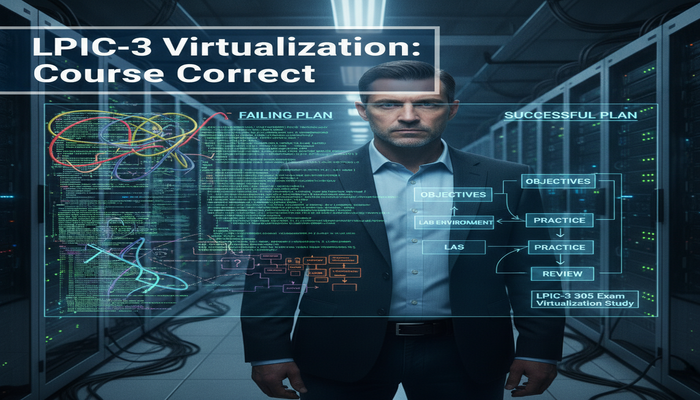
An IT professional analyzing a holographic display. One side shows chaotic, tangled data representing a failing LPIC-3 virtualization exam plan, while the other side illuminates a clear, structured study roadmap for LPIC-3 305 exam success. Text: LPIC-3 Virtualization: Course Correct.

Are you gearing up for the LPIC-3 Virtualization and Containerization exam, officially known as the LPIC-3 305-300? This advanced certification from LPI is a significant milestone for any Linux professional looking to master the complexities of virtualization and containerization technologies. While the prospect of earning your LPIC-3 certification is exciting, many candidates find themselves facing unexpected hurdles, leading to frustration and, often, failure. This article delves into the common reasons why aspiring professionals' LPIC-3 virtualization exam plans often fall short and, more importantly, how you can avoid these pitfalls to secure your success.

The LPIC-3 305-300 exam, part of the Linux Professional Institute's highest level of multi-certification, tests your in-depth knowledge and skills in managing various virtualization solutions, including full virtualization, containerization, and VM deployment. It's not merely about knowing the commands; it's about understanding the underlying concepts, architectural designs, and best practices. If you've ever wondered why your study efforts aren't yielding the desired results, or if you're just starting your preparation, this comprehensive guide is for you. We’ll explore the critical mistakes candidates make and provide a roadmap to help you craft a robust, successful LPIC-3 virtualization exam strategy.

The Allure and The Reality of LPIC-3 Certification

The LPIC-3 certification is a badge of honor, signifying a top-tier expert in Linux administration with specialized skills. For those aiming for the LPI Virtualization and Containerization certification, it translates into a deep understanding of technologies that are pivotal in modern IT infrastructure, from cloud environments to DevOps pipelines. The LPIC-3 305 exam covers essential topics like Xen, QEMU, Libvirt, LXC, and Docker, alongside cloud-native deployment tools like Packer, cloud-init, and Vagrant. Achieving this certification can significantly boost your career prospects, opening doors to advanced roles and higher earning potential, as evidenced by the growing demand for skilled IT professionals highlighted by the Bureau of Labor Statistics.

However, the journey to becoming an LPIC-3 certified professional is far from trivial. The exam's comprehensive nature and the depth of knowledge required demand more than superficial study. Many candidates underestimate the rigor, leading to flawed preparation plans. Understanding the scope, the LPI LPIC-3 305 exam syllabus, and the specific LPI 305-300 exam objectives is the first step toward building a successful plan. Without a clear understanding of the LPIC-3 Virtualization and Containerization certification requirements, your efforts might be misdirected.

Common Pitfalls: Why Your LPIC-3 Virtualization Exam Plan Fails

Preparing for an advanced exam like the LPIC-3 305 requires discipline, strategic planning, and the right resources. Many candidates stumble not because they lack intelligence or dedication, but because their approach to preparation is flawed. Let's dissect the most common reasons why LPIC-3 virtualization exam plans often fail.

1. Underestimating the Depth of the Exam

The LPIC-3 is not an entry-level or intermediate certification. It's designed for senior-level Linux professionals. Many candidates approach the LPIC-3 305-300 with the same study habits they used for LPIC-1 or LPIC-2, which is a critical mistake. The LPIC-3 Virtualization and Containerization exam delves deep into the architectural nuances, configuration intricacies, and troubleshooting methodologies of virtualization and containerization technologies. Simply memorizing commands or concepts won't suffice. You need a profound understanding of why things work the way they do, the implications of various configurations, and how to diagnose complex issues.

Candidates often fail to grasp the specific nuances of each technology covered, such as the differences in resource management between Xen and QEMU, or the intricacies of network bridging with Libvirt. The exam expects practical, real-world knowledge, not just theoretical recall. Without hands-on experience and a conceptual understanding of each LPI LPIC-3 305 exam topic, your plan is built on shaky ground.

2. Lack of a Structured Study Guide

Without a proper LPIC-3 Virtualization and Containerization study guide, candidates often jump between topics haphazardly. This leads to gaps in knowledge and inefficient use of study time. A structured approach, preferably following the official LPI 305-300 exam objectives, is paramount. Each objective typically represents a skill or knowledge area that will be tested. Ignoring these objectives or studying them out of order can leave you ill-prepared for certain sections of the exam.

Many focus on areas they find interesting or already know well, neglecting the more challenging or less familiar LPIC-3 305 exam curriculum V3.0 topics. This imbalance is a recipe for failure. A good study plan allocates time proportional to the topic weighting in the syllabus, ensuring comprehensive coverage.

3. Insufficient Hands-On Experience

The LPIC-3 virtualization exam is not just theoretical. It assesses your ability to implement and manage these technologies in a practical setting. Reading a book about Docker is one thing; actually building, deploying, and managing Docker containers is another. Without significant hands-on experience, you'll struggle with scenario-based questions and performance-related tasks implicitly tested by the exam. Setting up a lab environment is not optional; it's mandatory. This includes working with Xen hypervisors, deploying QEMU/KVM virtual machines, managing them with Libvirt, experimenting with LXC, and orchestrating Docker containers.

Practical application reinforces theoretical knowledge and helps you internalize complex concepts. Many candidates delay or skip the hands-on practice, assuming they can pick it up “later” or relying solely on theoretical study materials. This is a critical error for a practical, performance-focused certification like the LPIC-3 305.

4. Relying on Outdated or Incomplete Resources

The world of virtualization and containerization evolves rapidly. Relying on outdated books or online tutorials can lead to learning obsolete practices or missing crucial updates that are part of the LPIC-3 305 exam curriculum V3.0. Always verify your study materials against the official LPI documentation and the current exam version (V3.0 in this case). While there might not be a single “best books for LPIC-3 virtualization exam” for every topic, combining the latest official documentation, reputable online courses, and practical guides is essential.

Furthermore, some resources might provide only a superficial overview, failing to cover the depth required for the LPI Virtualization and Containerization certification. It's important to cross-reference information and ensure your study sources are comprehensive and current. For a detailed breakdown of the syllabus, refer to the official LPI LPIC-3 305 exam syllabus.

5. Neglecting Practice Questions and Mock Exams

Failing to incorporate LPIC-3 305 practice questions and full-length mock exams into your study plan is another common mistake. Practice questions help you: assess your understanding of specific topics, identify weak areas, become familiar with the LPIC-3 Virtualization and Containerization exam format, and manage your time effectively under exam conditions. Many candidates study diligently but skip this crucial step, entering the exam room without knowing what to expect or how to pace themselves.

Mock exams, especially, are invaluable for simulating the actual exam experience, including the 90 minutes duration and 60 questions. They can help you understand the LPIC-3 305 exam passing score of 500/800 and identify if you're consistently hitting that target. Don't just answer questions; analyze why an answer is correct or incorrect to deepen your understanding.

6. Poor Time Management and Procrastination

The LPIC-3 305-300 exam covers a significant amount of material. Effective time management is critical. Many candidates underestimate the time required for comprehensive study, hands-on practice, and review, leading to cramming sessions closer to the exam date. This superficial learning rarely sticks and often results in panic during the exam.

A realistic study schedule that breaks down the LPI LPIC-3 305 exam topics into manageable chunks, with dedicated time for each, is essential. Avoid procrastination and commit to your schedule. Remember, consistent, focused study over several weeks or months is far more effective than intense, last-minute cramming for a certification of this caliber.

Understanding the LPIC-3 305-300 Exam Details

Before diving into a foolproof plan, let's recap the essential LPIC-3 Virtualization and Containerization exam details:

  • Exam Name: LPIC-3 Virtualization and Containerization
  • Exam Code: 305-300
  • Exam Price: $200 (USD)
  • Duration: 90 mins
  • Number of Questions: 60
  • Passing Score: 500 / 800

These details highlight the need for efficiency and accuracy. With 60 questions in 90 minutes, you have approximately 1.5 minutes per question. This underscores the importance of not just knowing the material but being able to recall it quickly and apply it under pressure. Thorough familiarity with LPI 305-300 sample questions can help refine your speed and accuracy.

Navigating the LPIC-3 305-300 Syllabus: A Deep Dive

A critical step in avoiding failure is to deeply understand the LPI LPIC-3 305 exam syllabus. Each topic area has a specific weight, indicating its importance on the exam. Your study plan should reflect these weightings.

Full Virtualization (22%)

This section lays the groundwork for understanding how virtualization works at a fundamental level and then dives into specific hypervisors and management tools.

  • Virtualization Concepts and Theory - 6%: This covers the basic principles of virtualization, types of virtualization (full, paravirtualization, hardware-assisted), hypervisor types (Type 1 and Type 2), and key components like virtual machines, guest OS, host OS, and virtual hardware. Understanding this theoretical foundation is crucial before tackling specific implementations.
  • Xen - 3%: Focuses on the Xen hypervisor, including its architecture, domains (Dom0, DomU), network and storage configuration for Xen virtual machines, and management tools. While its weighting is lower, Xen remains a significant enterprise virtualization platform.
  • QEMU - 4%: This topic covers QEMU as a standalone emulator and its integration with KVM (Kernel-based Virtual Machine). You'll need to know how to create and manage virtual machines using QEMU/KVM, configure virtual hardware, and understand its performance aspects.
  • Libvirt Virtual Machine Management - 9%: Libvirt is a powerful virtualization management library and daemon that supports multiple hypervisors (KVM, QEMU, Xen, LXC). This is a high-weight topic. You'll need to master its command-line tools (virsh), configuration files (XML domains), network management (virsh net), storage pool management (virsh pool), and snapshotting capabilities. This is central to managing virtual machines on Linux.
  • Virtual Machine Disk Image Management - 3%: This covers various virtual disk formats (qcow2, raw, vmdk), their creation, conversion, resizing, and optimization. Efficient disk management is vital for performance and storage utilization in virtualized environments.

Container Virtualization (25%)

The modern IT landscape heavily relies on containers. This section covers their concepts, leading technologies, and orchestration.

  • Container Virtualization Concepts - 7%: Similar to full virtualization concepts, this introduces the fundamentals of containers: namespaces, cgroups, union file systems, container images vs. virtual machine images, and the benefits of containerization. Understanding the isolation and resource management mechanisms is key here.
  • LXC - 6%: Linux Containers (LXC) is an operating-system-level virtualization method for running multiple isolated Linux systems (containers) on a single control host. You'll need to know how to create, manage, and configure LXC containers, including networking and storage for them.
  • Docker - 9%: This is another high-weight topic, reflecting Docker's industry prevalence. Expect questions on Docker daemon, images (building with Dockerfiles), containers (running, stopping, managing), volumes, networks, Docker Compose for multi-container applications, and basic security considerations. Mastery of Docker is essential for the containerization certification LPI professional title.
  • Container Orchestration Platforms - 3%: While Docker Swarm and Kubernetes are major players here, this section might touch upon fundamental concepts of orchestration: service discovery, load balancing, scaling, and deployment strategies. Given the low weight, a high-level understanding of how these platforms manage containers is likely sufficient, rather than deep configuration details of a specific orchestrator.

VM Deployment and Provisioning (10%)

This section focuses on automating the deployment and management of virtual environments, crucial for cloud and DevOps workflows.

  • Cloud Management Tools - 2%: This might broadly cover concepts related to Infrastructure as Code (IaC) and how tools interact with cloud APIs to provision resources. Specific tool knowledge might be minimal given the low weighting, focusing more on principles.
  • Packer - 2%: Packer by HashiCorp is a tool for creating identical machine images for multiple platforms from a single source configuration. You'll need to understand how to use Packer to build images for various virtualization platforms (e.g., QEMU, cloud providers) and its configuration syntax.
  • cloud-init - 3%: cloud-init is the industry standard for cross-platform cloud instance initialization. It's used to customize cloud instances on first boot. You'll need to understand how to use cloud-init to configure networking, users, run scripts, and install packages when a VM first starts.
  • Vagrant - 3%: Vagrant by HashiCorp is a tool for building and managing virtual machine environments in a single workflow. It's often used by developers to create reproducible development environments. Understanding Vagrantfiles, provisioners, and box management is key.

As you can see, the LPI Virtualization and Containerization certification delves into a broad yet specialized set of skills. Each area demands focused attention. For more information on complementary certifications that enhance your Linux expertise, explore our article on unleashing the power of LPIC-3 Security.

Crafting a Winning LPIC-3 Virtualization Exam Strategy

Now that you understand the common pitfalls and the exam's structure, let's outline a strategy to ensure your LPIC-3 virtualization exam plan doesn't fail.

1. Master the Official LPI 305-300 Exam Objectives

This is your primary blueprint. Go through each objective on the official LPI website. Don't just read them; understand what each objective implies. For instance, if an objective states “Configure Xen network interfaces,” ensure you can practically perform this task and understand the various networking modes. Use the official objectives to create a checklist for your study plan.

2. Invest in Quality Study Materials and Resources

While there isn't one definitive book for the LPIC-3 305-300, a combination of resources is effective. This includes official LPI documentation, vendor-specific manuals (for Xen, QEMU, Docker), reputable online courses (e.g., from Linux Academy, A Cloud Guru, Pluralsight), and specialized books on virtualization and containerization. Prioritize resources that are up-to-date with V3.0 of the exam curriculum. Look for LPIC-3 Virtualization and Containerization study guide materials that offer both theoretical explanations and practical examples.

3. Build a Dedicated Home Lab

This cannot be stressed enough. A home lab where you can practice every single concept covered in the syllabus is invaluable. You'll need a Linux machine (physical or a powerful VM) capable of running nested virtualization if you want to experiment with KVM/QEMU, Xen, LXC, and Docker. Dedicate significant time to hands-on exercises: install hypervisors, create VMs, configure networks, build Docker images, deploy containers, and use provisioning tools like Vagrant and Packer. This practical experience is the cornerstone of passing the LPIC-3 virtualization exam.

4. Develop a Structured Study Schedule

Break down the LPI LPIC-3 305 exam topics according to their weighting and your current knowledge level. Allocate more time to high-weight areas and topics you find challenging. A sample schedule might look like:

  • Week 1-3: Full Virtualization Concepts, Xen, QEMU. Focus on understanding and lab exercises.
  • Week 4-6: Libvirt Virtual Machine Management, VM Disk Image Management. Deep dive into virsh commands and XML.
  • Week 7-9: Container Virtualization Concepts, LXC, Docker. Hands-on Dockerfiles, networks, volumes.
  • Week 10-11: Container Orchestration Platforms (concepts), Packer, cloud-init, Vagrant. Automation focus.
  • Week 12: Comprehensive Review, LPIC-3 305 practice questions, mock exams.

Adjust this based on your learning pace and prior experience. Consistency is key for the LPIC-3 305 exam duration. Regular, shorter study sessions are often more effective than infrequent, long ones.

5. Practice with LPIC-3 305 Practice Questions and Mock Exams

Once you've covered the material, shift your focus to practice questions. Look for high-quality LPI 305-300 sample questions that mirror the difficulty and format of the actual exam. Take full-length mock exams under timed conditions to simulate the LPIC-3 305 exam duration and pressure. Analyze your results meticulously: understand why you got questions wrong, revisit those topics, and re-test. This iterative process helps solidify your knowledge and improve your exam-taking strategy. Aim to consistently score above the LPIC-3 305 exam passing score of 500/800 in your practice tests before scheduling your exam.

6. Understand the LPIC-3 305 Exam Format

Knowing the LPIC-3 Virtualization and Containerization exam format (multiple-choice, fill-in-the-blank, etc.) and question types can help you prepare mentally. While specific examples aren't always released, general knowledge of LPI exam styles will aid you. Practice managing your time, reading questions carefully, and eliminating incorrect answers strategically. Don't let the pressure of the LPI LPIC-3 305 exam duration intimidate you; proper practice will build confidence.

Beyond the Exam: The Value of LPIC-3 Virtualization and Containerization

Successfully passing the LPIC-3 305-300 exam is more than just earning a certificate; it's about validating a highly sought-after skill set. With businesses rapidly adopting cloud-native architectures and microservices, the demand for professionals proficient in Linux virtualization and containerization has skyrocketed. The LPI Virtualization and Containerization certification directly addresses this industry need, proving your capability to design, implement, and manage these critical technologies.

Holding this certification positions you as an expert capable of handling complex infrastructure challenges, optimizing resource utilization, and driving innovation within organizations. It signifies your readiness for roles such as Senior Linux Administrator, DevOps Engineer, Cloud Engineer, or Solutions Architect. The LPI LPIC-3 305 exam topics are directly relevant to the tasks performed in these high-impact positions, making the certification a tangible asset for career advancement.

Moreover, the process of studying for the LPIC-3 virtualization exam itself deepens your understanding of Linux systems and modern infrastructure practices, making you a more versatile and valuable professional. It's an investment in your continuous professional development, ensuring you stay at the forefront of technological advancements in the Linux ecosystem. The comprehensive knowledge gained from understanding the LPIC-3 305 exam curriculum V3.0 equips you with tools to tackle real-world problems efficiently.

Conclusion

Your LPIC-3 virtualization exam plan doesn't have to fail. By understanding the common pitfalls – underestimating exam depth, lacking a structured study guide, insufficient hands-on experience, using outdated resources, neglecting practice questions, and poor time management – you can build a robust strategy for success. The LPI Virtualization and Containerization certification is challenging, but incredibly rewarding.

Focus on mastering the official LPI 305-300 exam objectives, leveraging quality study materials, dedicating time to a hands-on lab, and diligently practicing with LPIC-3 305 practice questions. With a well-structured approach and consistent effort, you'll not only pass the LPIC-3 305-300 exam but also emerge as a highly skilled and confident Linux professional ready to tackle the demands of modern IT infrastructure. Your journey to advanced Linux expertise starts with a solid plan, and with the insights shared here, you are well-equipped to achieve your LPIC-3 certification goals. For more insights into specialized Linux certifications, don't miss our article on how a training institute in Bahrain supports LPI certifications.

Ready to validate your expert-level skills? Visit Pearson VUE to schedule your LPIC-3 305-300 exam today and take the next leap in your Linux career!

Frequently Asked Questions About the LPIC-3 Virtualization Exam

1. What is the LPIC-3 Virtualization and Containerization certification?

The LPIC-3 Virtualization and Containerization (Exam 305-300) is one of the three specialty exams required to achieve the highest level of LPI certification, LPIC-3. It validates advanced skills in managing full virtualization technologies (like Xen, KVM/QEMU, Libvirt) and containerization solutions (like LXC, Docker), as well as VM deployment and provisioning tools (Packer, cloud-init, Vagrant).

2. How difficult is the LPIC-3 305-300 exam compared to LPIC-1 or LPIC-2?

The LPIC-3 305-300 exam is significantly more difficult than LPIC-1 or LPIC-2. It requires not just a broad understanding but deep, practical expertise in complex virtualization and containerization technologies. Candidates need extensive hands-on experience and a strong grasp of architectural concepts, troubleshooting, and best practices, going well beyond the foundational and intermediate levels.

3. What are the prerequisites for taking the LPIC-3 Virtualization exam?

To be LPIC-3 certified, you must hold an active LPIC-2 certification. While it's technically possible to take the LPIC-3 305-300 exam without having LPIC-2, you won't be granted the LPIC-3 certification until you also pass the LPIC-2 exams. It is strongly recommended to have a solid background in LPIC-1 and LPIC-2 topics before attempting LPIC-3.

4. What is the best way to prepare for the LPIC-3 305-300 exam?

The best preparation involves a multi-faceted approach: thoroughly studying the official LPI 305-300 exam objectives, building a dedicated home lab for extensive hands-on practice, using up-to-date and comprehensive study materials, taking LPIC-3 305 practice questions, and conducting full-length mock exams under timed conditions. Consistent study over several months is more effective than cramming.

5. How much does the LPIC-3 305-300 exam cost and what is its passing score?

The LPIC-3 305-300 exam costs $200 (USD). The passing score for the exam is 500 out of a maximum of 800. It consists of 60 questions and has a duration of 90 minutes. Adequate preparation, including timed practice tests, is crucial to meet this passing score within the allocated time.